ASADA and the NISU get to grips with ethical decision-making in sport
Examining the ethical decision-making process with Australian athletes and athlete support.


The challenge
Replicating face-to-face learning online
In recent years, the decision-making processes of athletes and athlete support personnel has come under scrutiny as they walk the very fine line between competing fairly and cheating. Doping cases, both here in Australia and internationally, show the level to which some athletes and athlete support personnel will go to achieve success.
ASADA and NISU faced enormous pressure from the public and the government to tackle the issue. In response, the two agencies developed a face-to-face programme with Bluestone Edge. The 90-minute programme was designed around engaging the participants in a series of ethical dilemmas, providing them with the facts and asking them to make a choice. The facilitator would then lead a guided discussion, in the style of SBS’s Insight programme, over why they made the choice they did.
With the success of the face-to-face programme, ASADA and NISU decide to develop an online version to reach greater numbers. The challenge was to replicate a face-to-face programme that was designed to start conversation and the unpacking of the decision-making process which is made even more difficult when there are no right or wrong answers, nor do the participants want their responses tracked.
The solution
Scenario-based online learning
Joining forces once again, ASADA and Mindtools Kineo worked together to develop a ground breaking solution that mimicked as closely as possible the face-to-face programme. The result is a course, built on the Adapt Framework, that challenges the learners to carefully consider situations they may face in their sporting life that may blur the line of fair play and cheating.
Using the content developed for ASADA and NISU by Bluestone Edge, the team at Mindtools Kineo worked with the ASADA Education team to craft a course that would achieve results similar to that of the face-to-face programme. This required some out of the box thinking and some bespoke development in the Adapt Framework to achieve the desired result.
Bite-sized learning
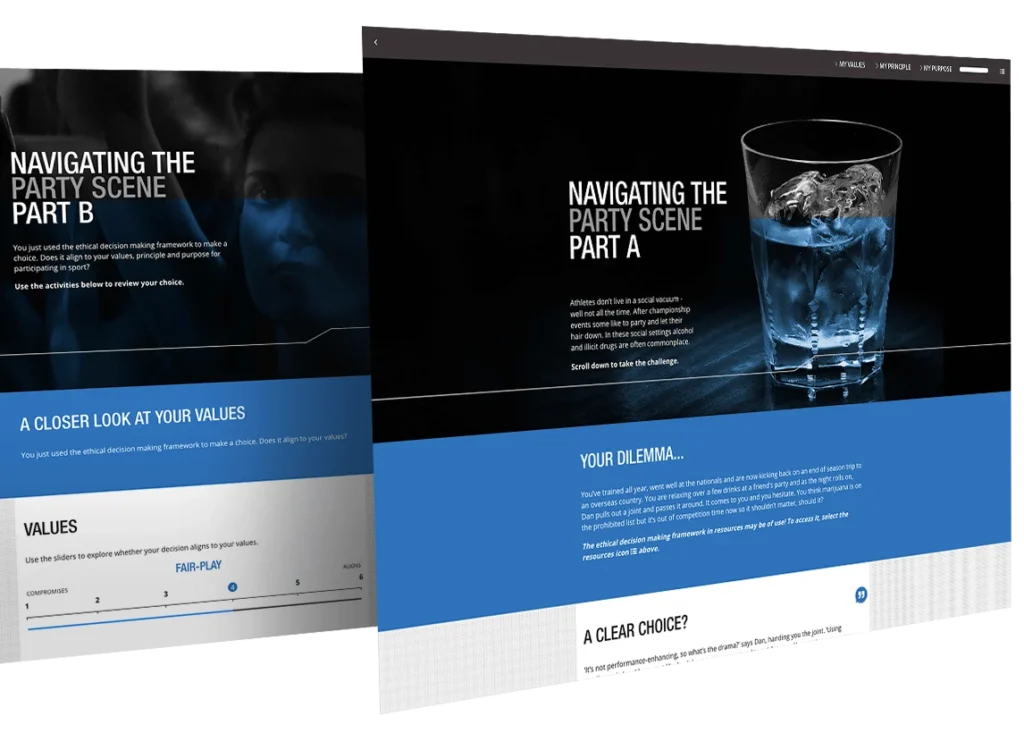
The biggest challenge for the development of the course was to condense the theory down to a manageable, bite-sized chunk. The learners are guided through the basic theory of ethical decision making, exploring their values and principles, as well as their reason for participating in sport.
A key component of the face-to-face programme is for the participants to identify their values and principles and use them in the decision-making framework during the scenarios.
Functionality was specifically developed by Mindtools Kineo to enable the selections made in this part of the course to be carried through to the three scenarios and have the learner identify how the decision they make aligns with their identified values and principles. This ties together the theory of decision-making and making the choice when presented with a tricky decision, which is the entire purpose of the course.
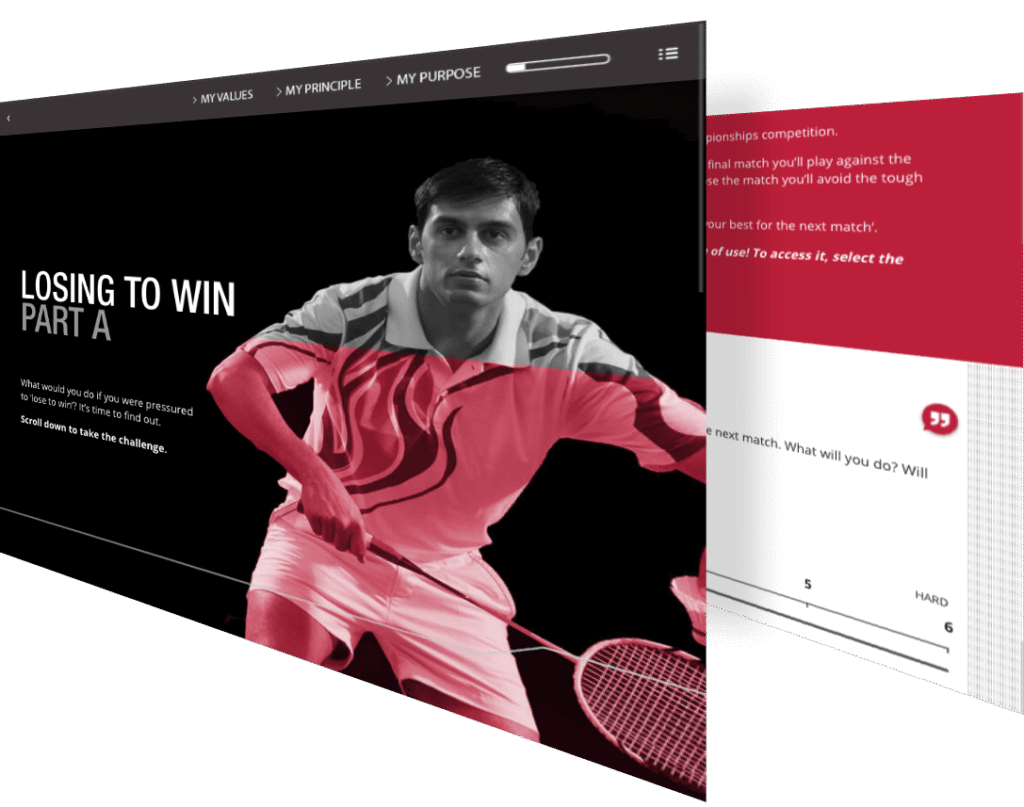
Integrity in sport covers several different areas, including doping, illicit drugs and match fixing. Each of these areas has a scenario that places the learner in a difficult position that requires them to reflect on their values and principles, then apply that to the decision. After the choice is made, the decision is revisited, but with a twist, to see if the learner would stick to their guns or change the decision.
The results
Informative and effective
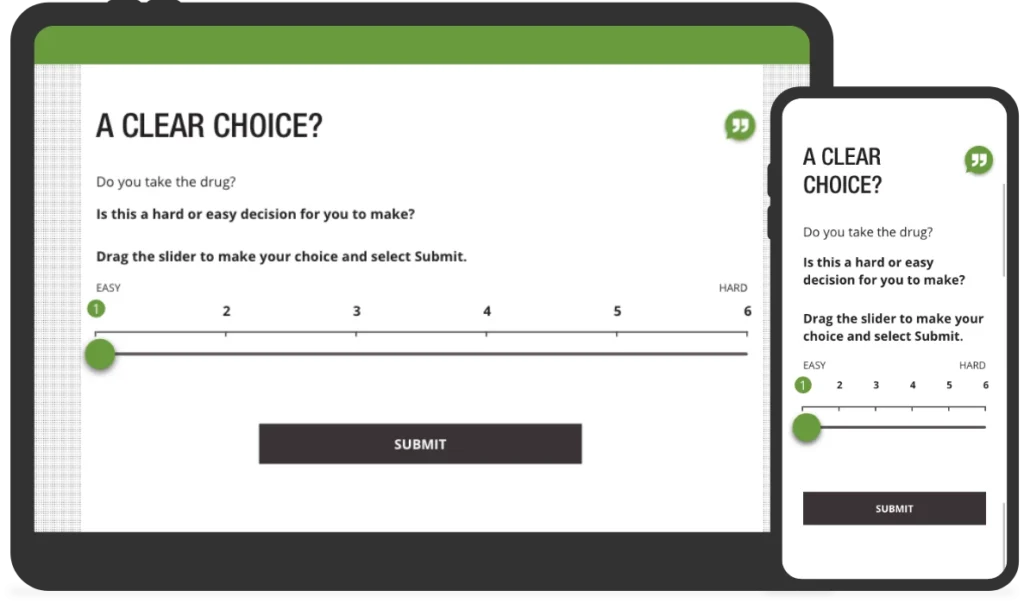
The face-to-face programme is designed to challenge the participants understanding of their decision-making processes. The online equivalent has made great use of the Adapt Framework to give learners a comparable experience that can be accessed anywhere, on any device.
In contrast to the anti-doping course previously developed, Ethical Decision Making is not mandatory, yet it has seen 331 completions since launch in October 2016. 88% of the 156 survey respondents were satisfied or very satisfied with the course, and over 86% stated they are more likely to consider their values and principles when making decisions around sport integrity issues.
Mindtools Kineo and ASADA won Platinum for Best free elearning resource at the LearnX Awards in 2017 with this project.