How often have you or someone you know said the following?
- “It’s falling on deaf ears”
- “I’m just going to turn a blind eye”
- “That’s insane/crazy/mad!”
- “The weather is so bipolar”
- “Today is so depressing”
We’ve probably all used phrases like this without considering the impact on those affected by mental health conditions or disabilities. We mean no harm and may say these phrases without thinking about how it makes others feel or just because it’s so common in everyday language. Or, quite frankly, maybe we’ve just never stopped to consider it before.
Words have power – they can evoke emotions, be inspiring, or persuasive or cause harm. Words set the scene and guide the learner every step of the way. Your word choice must be considered and thought through in a professional context, especially within a learning experience.
As learning designers, we need to be aware, ready to learn and acknowledge the impact our words have towards creating a more inclusive and welcoming learning environment. We also need to be ready to continuously learn about language and its impact – and be ready to adapt and change when required.

In this blog we begin to explore the importance and impact of language on those around us and specifically through our learning experiences. This is an introduction to this very complex topic. We are in this together and we invite all our clients to have open discussions with us in order for us to all continuously improve in this fundamental area.
Let’s begin to explore the impact of language
Put simply, language is how we communicate and connect with each other. It’s actually astounding when you think about the complex concepts we can convey and the beauty in sharing stories and positive feelings.
In recent years, society has become increasingly aware of how we use language and the impact it has. We have seen this demonstrated in the way we address instances of racist and sexist language, yet ableist language, in written and spoken form, persists. Language is a powerful force that can either unite or divide. Ableist language not only minimises the experiences of people with disabilities but also perpetuates harmful stereotypes.
Take the following example of an introductory statement that you might include at the beginning of a course:
“This course will build your understanding in areas where you’re less knowledgeable, so you walk away feeling more confident.”
There’s nothing in the course material or content that requires the learner to be able to walk – it’s a term that immediately and needlessly ostracises wheelchair users and those unable to walk. A simple but thoughtful change in language changes this:
“This course will continue building your understanding in areas where you’re less knowledgeable, so you feel more confident.”
How can we better understand ableism?
In its purest definition, ableism is the discrimination and oppression of people with disabilities. This is often unintentional but implies the belief that non-disabled people are superior to disabled people. When you use a phrase such as “mad”, “deaf ears” or “crippled by the amount of work” – you are projecting connotations that a disability is negative. These phrases are, for the most parts, not said as a compliment.
It can be harmful, belittling and offensive to disabled people and those who care for them – and whilst this type of language might not always be intentional, they can be seen as micro-assaults. Unfortunately, it’s become ingrained in our society to say certain phrases. We see the Kardashians or our favourite sports pundits calling each other a bit OCD or dumb, and it quickly becomes part of our everyday vocabulary. But, we can (and should) do better than this.
Remember, listening is your superpower
Have open conversations with people and find out what’s made them feel uncomfortable in the past and what they’d like to see change in the future. Show support and empathy for one another. And be ready to learn and acknowledge that you might not have always been right in the past.
How we can employ inclusive learning design
In the courses we create for our clients, we want (and need) to be as inclusive as possible. Incorporating accessibility measures, such as using alternative text on images, closed captions on video, being mindful of screen colour, and considering text surrounding interactivity ensures that our courses are optimised for diverse needs.
Think of a course where you are asking the learner to complete a task. They need to select the correct answer from a multiple choice. Instead of using the prompt “Look below and click on the right answer” to make this more inclusive, especially to those using screen readers, you’d change it to “Continue on and select the right answer from the list”.
This needs to be a priority
This extends to the words we choose to use and so as a team, we’re also considering ableist language and thinking about the terms we use. Applying these small changes will make our courses as accessible as possible meaning our learners can experience learning which is optimised to their needs and feels as welcoming as possible.
Words matter, so choose them wisely
When we use ableist language we are minimising the experiences of people with disabilities. Beyond seeing someone with a physical disability, many people may not reveal they have a non-visible disability or mental health condition. To combat ableism, we must be mindful of the language we use and think about how to be more inclusive.
Let’s reimagine our language, one word at a time.
Instead of perpetuating micro-aggressive language, let’s opt for alternatives that promote inclusivity. We can begin to do this by improving our everyday language and by being more careful regarding how we describe certain things.
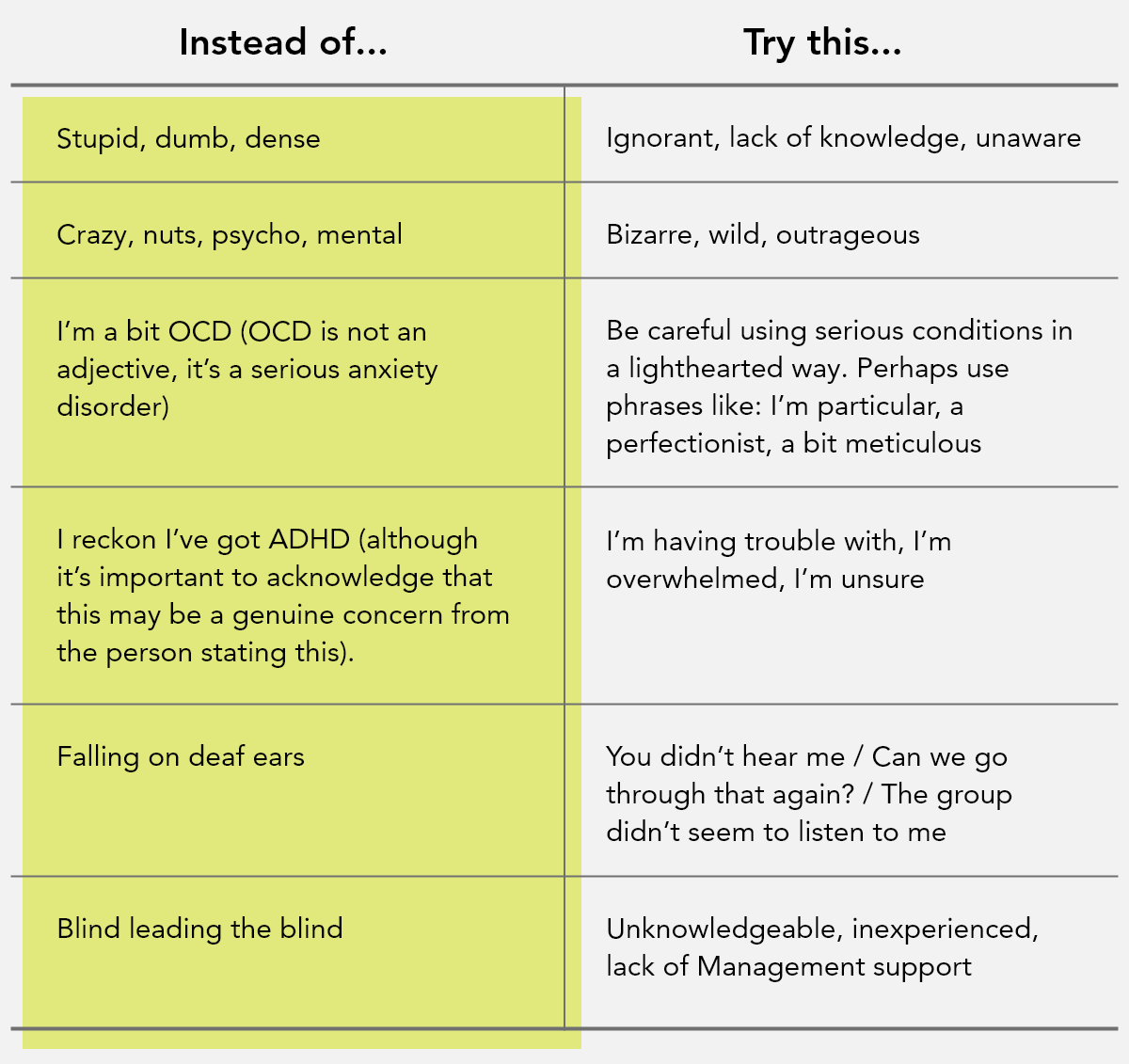
A call to improve: this is just the start of a bigger conversation
These are only a few examples, and it will take a lot more time to realise the impact of what we are saying or writing. It will be challenging because changing behaviour always is…you may also have to change language you’ve used all your life!
This is about continuous learning and we have a responsibility to improve and build our knowledge – and be better.
Be ready to challenge yourself and others
Recognising the impact of our words requires a conscious effort, and though challenging, we hope you’ll agree it’s worth it. This is just the beginning! As learning designers, let’s champion this cause within our courses, fostering an environment where everyone, regardless of ability, feels seen, heard, and valued. Share this article with your peers and initiate conversations about the impact of language and ableism in learning design.
Let’s chat!
You can also get in touch with the team here if you’d like a review of the language in your current courses.
Helpful resources:
There are many fantastic resources about inclusive language in the world of learning and education. Here are a few that we found especially helpful: