The future of AI’s success rests with employers
Our analysis reveals the massive economic potential of AI. But organizations will need to transform employee mindsets around AI if they want to enjoy any of that value.
We call this gap between the organizations that build AI fluency and those that don’t the ‘AI Divide’. And confidence is where that divide shows up first.


Key sections
The trillion-dollar opportunity
The US economy could be boosted by $1.34 trillion by 2030 through AI upskilling alone. But what needs to happen to make that figure a reality?
Put simply, employers need to step up. Educational institutions and independent learning don’t have the reach to influence enough of the workforce.
In fact, our analysis found that organizations will have to shoulder at least 75% of the responsibility for building AI capability in the workforce through better skills development.

Current efforts are falling short
Organizations aren’t yet equipped to rise to this challenge. Instead, it appears that upskilling is being outright neglected.
Almost two-thirds (64%) of firms using AI reported that they’ve made no institutional adjustments at all since adopting the technology. Even more worryingly, only 15% said that they had trained staff and developed new workflows.
This is a significant problem since, without proper investment in development, workers won’t have the skills or confidence to use the technology consistently. The data shows just how much this impacts adoption, with only 18% of employees who have received no training being classified as ‘regular AI users’.
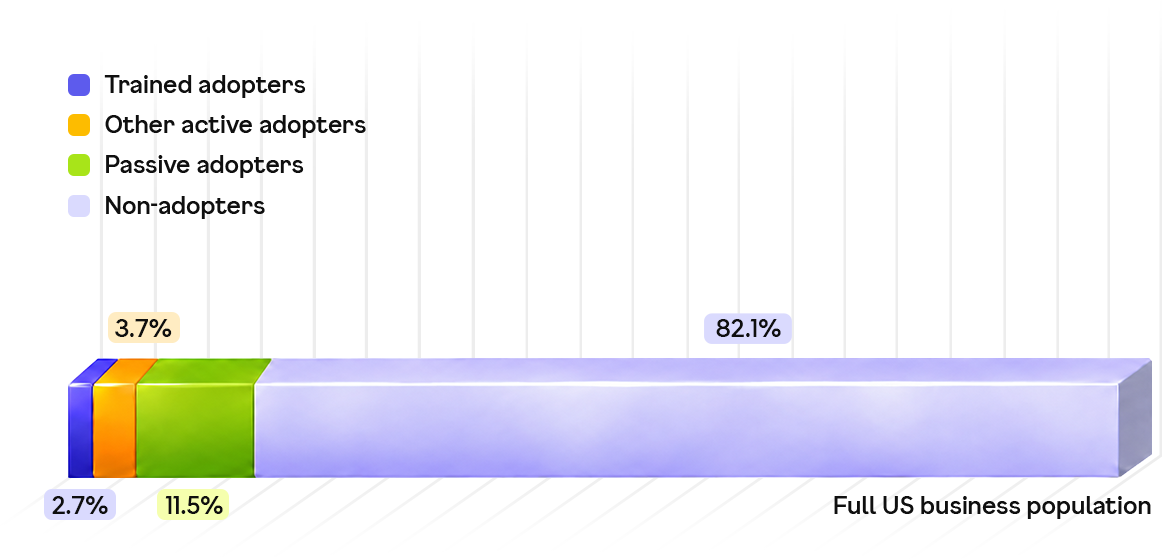
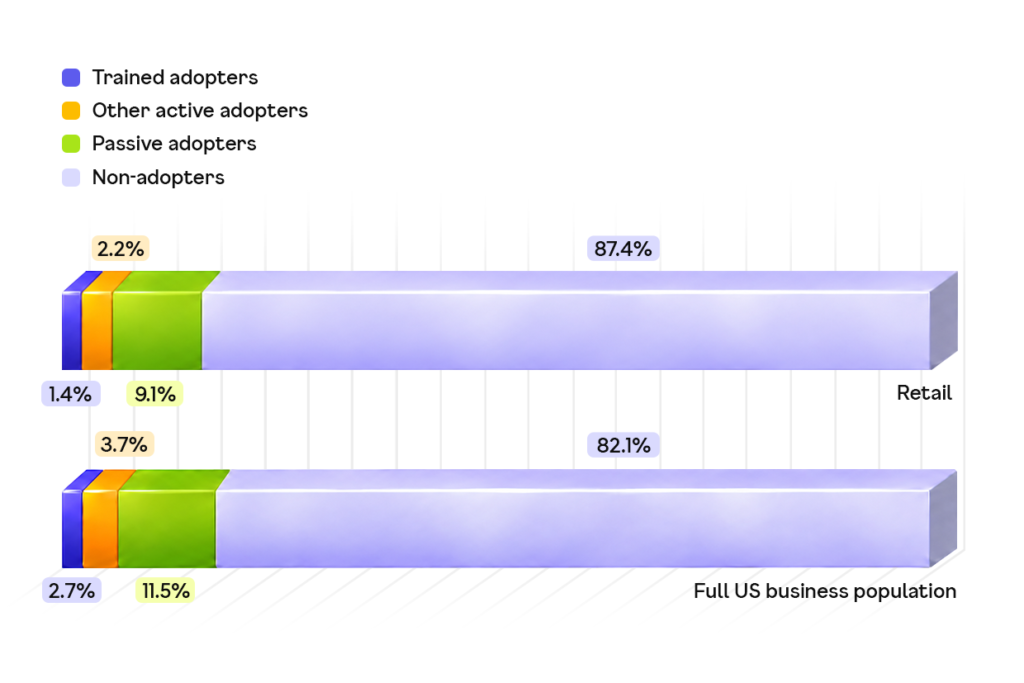
Across the full US business population, the current split currently looks like
But the data reveals a very different story when examined on a sector-by-sector basis
Information
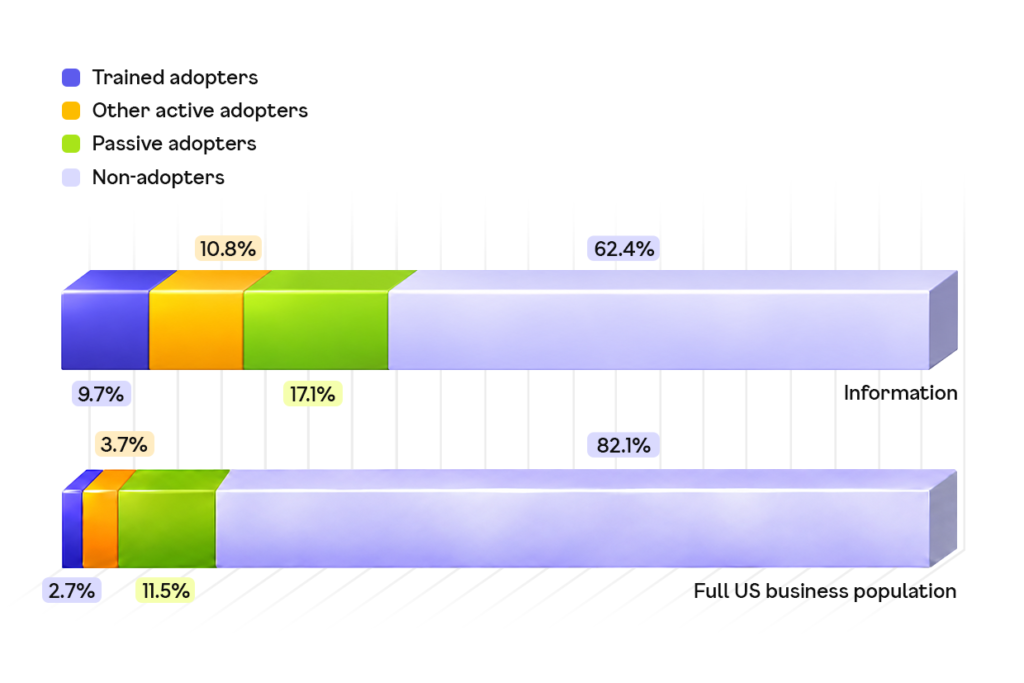
Information, a sector that includes organizations ranging from telcos to data services providers, is the most advanced overall and is well above the national average. Nearly two-fifths of businesses (38%) are currently using AI, and a fifth (21%) of the whole sector has implemented some form of organizational adaptation.
Even so, only one-in-10 information organizations (10%) have reached the point of both adopting AI and training their existing staff.
Finance & insurance
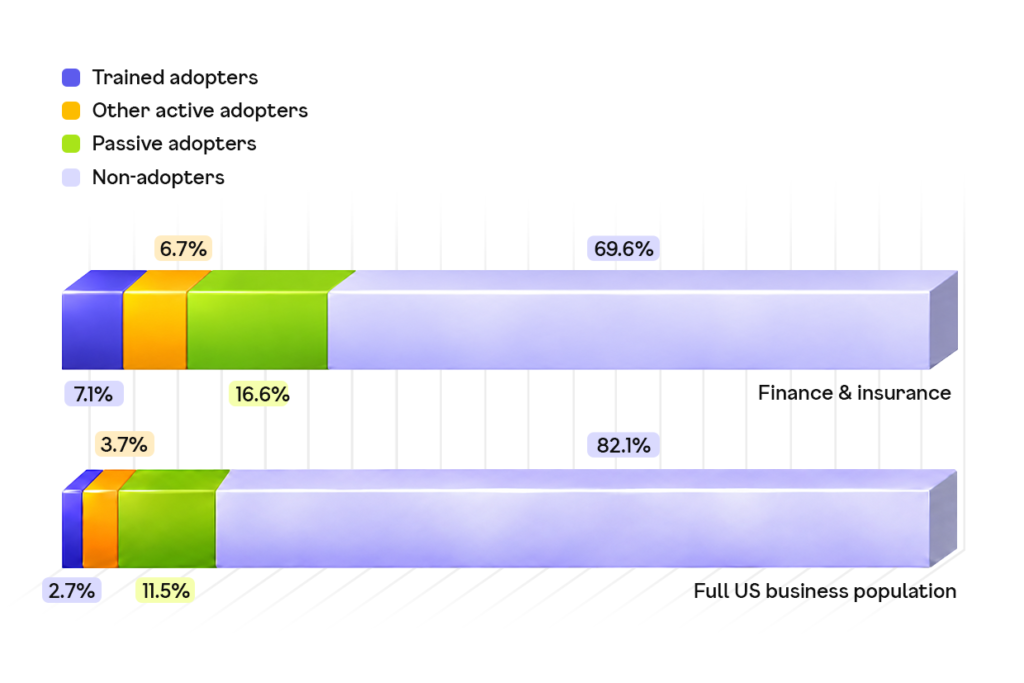
While not leading the pack, finance and insurance are among America’s most advanced AI-adopting industries — almost a third of firms in these sectors (30%) have adopted AI.
However, with training adopters making up just 7% of total businesses, there is still considerable progress to be made.
Educational services
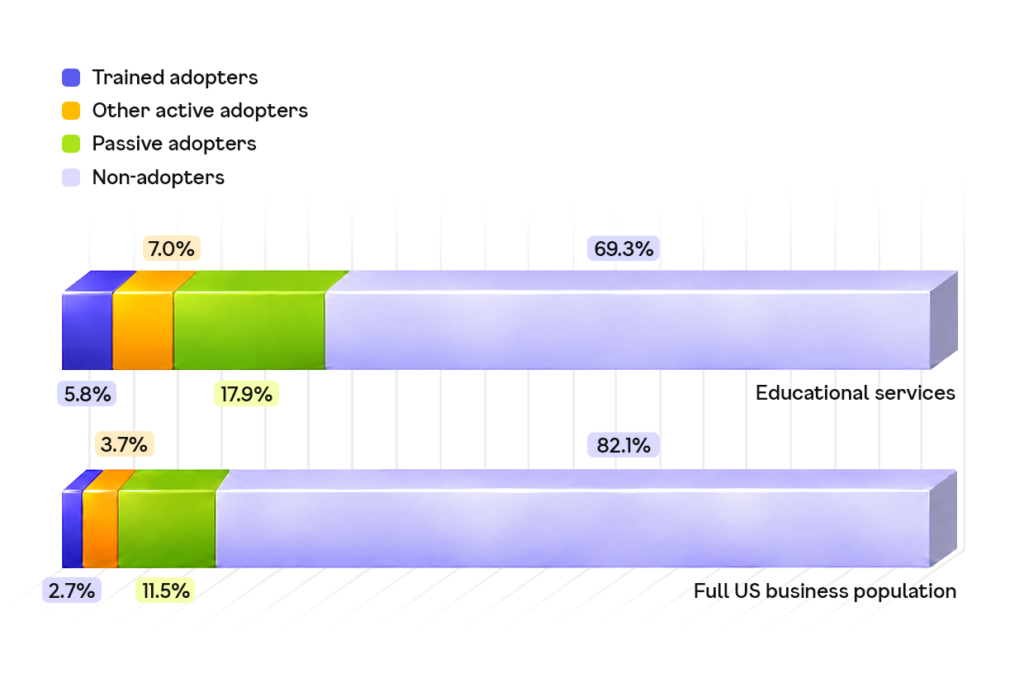
Education has one of the clearest deployment-to-readiness gaps. Almost one-third (31%) of institutions use AI, but only 6% of the entire sector have both adopted the technology and trained existing staff. Meanwhile, a staggering 18% of education organizations are ‘passive adopters’ — the highest of any other sector.
Retail
Retail faces the biggest challenge. Only 13% have adopted AI, and just 1% of all retail organizations have trained their staff on AI.
The sector therefore faces a battle on two fronts: expanding adoption while ensuring that deployment is accompanied by the skills needed to use AI effectively.
Why development is the key to success
There’s a definitive link between skills development and employees increasing how regularly they use AI. But it’s also clear that the more in-depth the learning experience, the better the return. And that’s because it’s as much about the ‘type’ of training as it is about ‘time spent’.
Broadly speaking, there are three kinds of approaches that firms can take when it comes to skills development.
Basic
A basic/lower-intensity model, which is often tool-led and has shorter instruction, will make a big difference compared to none at all. But there’s still room for more to be done:
Nearly two-thirds (63%) of employees who received 1–5 hours of training are regular AI users — that’s 3.5 times the number of employees who received none.
Applied
An applied/substantive model that consists of hands-on learning and is linked to real tasks will see better results:
Over four-fifths (82%) of employees who received 5–10 hours of training are regular AI users.
Embedded
An embedded/intensive model, combining sustained learning with practical application and ongoing organizational support, offers the most effective approach. This results in a workforce with the skills and mindset needed to engage with AI as a co-worker rather than just a tool.
Nine-in-ten (89%) of employees who received more than 10 hours of training are regular AI users.
As the models extend beyond the 5–10-hour mark, the gains start flattening out. This suggests that, once a basic threshold is crossed, the design of the learning experience becomes increasingly important for converting upskilling into sustained use.
While each program should look different depending on the organization, there are some universally agreed-upon guidelines for what good looks like. The US Department of Labor released guidance to improve ‘AI literacy’ and identified a number of themes, including:
Experiential — hands-on learning will be much more effective than abstract instruction.
Contextual — skills development works better when it is tied to an employee’s day-to-day job.
Holistic — upskilling needs to address the barriers to AI literacy where necessary, ensuring learners have general digital literacy skills as well.
Supported — managers should themselves have an understanding of AI to better support workers.
Continuous — as models evolve, upskilling programs need to adapt in step.
The data speaks for itself
Did you know? Mindtools Kineo has launched AI Skills Academy, a new enterprise AI enablement program in partnership with Mindstone, the AI upskilling experts.
Learners that underwent a four-week AI upskilling program from Mindstone started using AI 71% more after the experience. On average, participants used AI 18 hours a month post-program compared to just 10.7 hours beforehand. Learners also reported a 55% uptick in AI confidence after upskilling.

The value of skills development
Combining all of the findings above, we can map how much economic value each development model could unlock for the US economy:
Basic
The basic model would only generate $124 billion
Applied
Applied programs would realize $177 billion
Embedded
Embedded upskilling would deliver $196 billion
At the same opportunity and training reach, the embedded scenario produces around $72 billion more modeled value than the basic scenario — roughly 58% more.
METHODOLOGY
A record of where we sourced our figures and a detailed breakdown of our analysis
$1.34 trillion could be added to the US economy by 2030 just through AI upskilling.
The Generative AI and Economic Growth (2025) report from KPMG analyzed multiple scenarios of AI adoption and how they might impact US Gross Domestic Product (GDP). The report suggested that rapid GenAI adoption with upskilling could boost US GDP by $2.84 trillion above the baseline by 2030. In the alternative, rapid GenAI adoption without upskilling could boost US GDP by approximately $1.50–$1.55 trillion by 2030. That makes a difference of $1.29–$1.34 trillion between the two scenarios, isolating the economic difference that upskilling makes in a rapid GenAI adoption scenario.
For the purposes of our analysis, we used the upper band figure of $1.34 trillion.
At least 75% of the responsibility for building AI capability in the workforce sits with employers.
Adult learning is already common in the US. The Trends in Adult Learning: New Data from the 2023 Survey of Adult Skills (2025) report from OECD shows that 55% of US adults aged 25–65 participated in formal education or organized job-related training outside formal education in 2023. Addressing the Barriers Blocking Employee Development (2025) from Gallup separately found that 45% of US employees participated in education or training to build new skills for their current job in 2024.
These routes overlap heavily with employment. Adult learning may be employer-funded, take place during paid working time or be delivered in the workplace; the same individual may also appear in education and workplace-training measures. We therefore do not treat education, independent learning and employer training as separate slices that add to 100%. Instead, the model uses direct evidence on employer involvement in job-related learning to anchor the share of the AI capability challenge that employers could realistically address.
To that end, the Trends in Adult Learning: New Data from the 2023 Survey of Adult Skills (2025) report found that, in the US, about 65% of organized job-related training outside formal education receives at least some financial support from employers. More specifically for an AI context, among US workers who experienced a significant change in information and communication technology (ICT) at work, 75% of those receiving training to adapt had that training financed by their employer.
Although it would be reasonable to assume that this figure could feasibly rise above the observed ICT-change level due to the wide-spread, rapid adoption of AI and the global investment in the technology, we ultimately chose to use the 75% figure as a conservative estimate of how much responsibility rests with employers. Within this estimation, the remaining 25% would be covered by formal educational institutions or independent learning.
64% of firms using AI reported they’ve made no institutional adjustments since adopting AI; 15% reported they’ve trained staff and developed new workflows since adopting AI.
Both of these claims are sourced from The Microstructure of AI Diffusion: Evidence from Firms, Business Functions, and Worker Tasks (2026) by the US Census Bureau.
18% of employees who have received no training being classified as ‘regular AI users’; 63% of employees who received 1–5 hours of training are regular AI users; 82% of employees who received 5–10 hours of training are regular AI users; 89%) of employees who received more than 10 hours of training are regular AI users.
These figures were sourced from AI at Work: Momentum Builds, but Gaps Remain (2025) by Boston Consulting Group.
Of the full US business population: training adopters make up 2.7%; other active adopters make up 3.7%; passive adopters make up 11.5%; non-adopters make up 82.1%.
These figures were sourced from Business Trends and Outlook Survey, 2025–26 AI Supplement; National Response Estimates and Sector Response Estimates (2026) by the US Census Bureau. The sector-by-sector split was also obtained from this resource.
Following a four-week AI upskilling program from Mindstone, learners: started using AI 71% more after the experience; participants used AI 18 hours a month post-program compared to just 10.7 hours beforehand; reported a 55% uptick in AI confidence after upskilling.
These figures were sourced from Mindstone’s 2025 Impact Report, The ROI of AI Upskilling (2025).
Basic skills development models would generate $124 billion for the US economy; applied models would generate $177 billion; embedded models would deliver $196 billion.
KPMG’s $1.34tn value associated with upskilling does not represent workplace training alone. Its scenarios also include education, policy, investment and wider organizational conditions. Before modelling training reach and quality, we therefore test two separate questions.
The first question is how much of the $1.34tn depends directly on people learning and applying new skills. While it’s not possible to quantify this exactly, we estimate this figure would be between 40–70%. For the sake of landing on a singular figure rather than a range, we used the median of this range, therefore operating under the assumption that 55% of the $1.34tn depends directly on people learning and applying new skills.
The second question is how much of that skills-related opportunity employers are likely to need to address through workplace training. For this figure, we used the 75% from OECD’s Trends in Adult Learning: New Data from the 2023 Survey of Adult Skills (2025).
Combining these figures (1.34 trillion x 0.55 x 0.75), we arrived at $553 billion as the gross economic opportunity workplace training could influence.
We then needed to account for the general effectiveness of workplace training, without accounting for the quality of the upskilling program. As such, we made the assumption that, in a realistic scenario, workplace training would only reach 50% of the workforce. This brings the $553 billion figure to $276.5 billion.
To then calculate how much the basic/applied/embedded model would generate, we took the figures from AI at Work: Momentum Builds, but Gaps Remain (2025) by Boston Consulting Group and multiplied $276.5 billion against the percentage-point uplift that each model had against the baseline. For the basic, applied, and embedded models, this figure is +45pp, +64pp, and +71pp respectively.
For the basic model, for example, this calculation would, therefore, look like: (($1.34 trillion x 0.55 x 0.75) x 0.50) x 0.45 = $124 billion (rounded to the nearest billion).