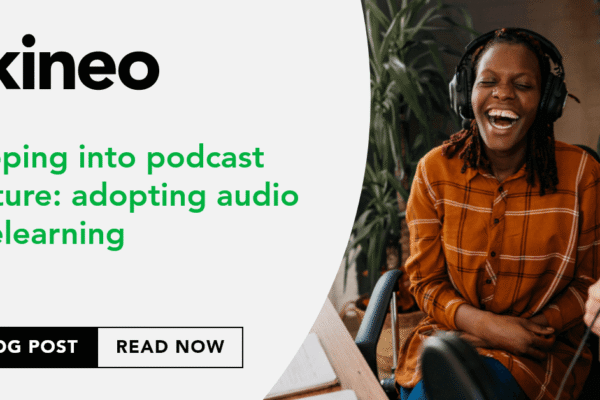
The rise of podcast culture has been phenomenal over the last few years and popularity in the medium doesn’t seem to be stopping anytime soon. Gone are the days where small talk is about best-selling books or series on Netflix – now we are actively engaging in long conversations about podcasts and which to listen to, avoid or binge on our next long train journey.
It’s interesting to consider why there has been a huge rise in podcasts and an increase in listeners, since the technology involved isn’t new or particularly advanced. Perhaps there is some charm in the simplicity of the format? Or the conversational tone makes it seem like we’re just dropping into a conversation with friends. Does this almost faux-personalised approach make us feel more worthy of being a listener or a fan?

Whichever way you look at it, podcasts and audio is here to stay. So, maybe it’s time we embrace both in the workplace too?
So, how does this apply to learning?
We are always keen to explore new ways of experiencing and embracing learning and new ways of slicing and dicing long training programmes. There’s genuinely a lot we can learn from the rise of the podcast. People consume podcasts in all types of environments; at the gym, on public transport, whilst walking the dog or even whilst doing chores around the house. There’s an interesting dynamic here between focused listening and background listening. Could ‘less important’ content or easy-on-the-ear content be delivered in audio to mix up how some learning is delivered?
In our time-poor working world, many professionals find it hard to dedicate time to personal development or even essential training for their career progression. Perhaps by embracing an audio format busy learners could find the time to access learning opportunities and absorb new information. The conversation around the rise of microlearning really fits in well here too. Could certain individuals benefit from bitesize audio clips that last 5-10 minutes that they can easily listen to on their commute or whilst cooking their evening stirfry?
The multisensory advantage
There is a clear advantage to supplementing traditional learning with audio elements, but you need to think carefully about how and when. Research by Clark and Mayer shows that audio complements visual content in elearning by engaging multiple senses. But when you combine graphics, audio and text you risk tipping over into overwhelming the learner.
How can you adopt and embrace audio in your learning programmes?
Some examples:
- Using narration as a device to enhance specific learning content e.g. when using diagrams to explain complex concepts. Mayer’s work shows that the use of audio works particularly well with complex graphics or animations where you want to tell a story.
- Use audio to enhance animations or graphics. There might be cases when the graphics or animation speaks for itself and you don’t need a narrative to make it work, but consider how audio could add something to the experience. You might use sound effects for dramatic effect or to build tension in a story or game.
- Using music to separate training modules or as ‘background noise’ in interactive content when learners are meant to be working. Background music can also really influence the emotional atmosphere of elearning courses and can be utilised really effectively in many ways, like in reflection tasks or more creative tasks.
- Adopt a podcast approach and create content in audio form for on-the-move learning e.g. for a series of internal comms messages about organisational change or for sharing success stories like internal staff interviews.
The importance of accessibility and inclusivity
Whilst the rise of the podcast and the injection of audio into our everyday lives is exciting and gives us lots of new opportunities – it’s important to also consider accessibility here.
There are many benefits to the use of audio for learners with visual impairments or those with dyslexia. Many learners find that they learn better through hearing than by reading for example. However, with these opportunities, it’s also important to remember that those with hearing impairments will not always be able to access this type of content.
We encourage you to approach all your learning experiences with compassion and an open mind and to always remember that everyone learns differently and many learners have specific needs too. By giving a variety of formats and options for how to access or absorb information you are ensuring you are meeting these needs and you’re being inclusive and welcoming to all.
The rise of audio in our daily lives is something that we can’t ignore. This brings many opportunities for L&D teams to embrace microlearning or different audio-techniques in their learning content.
If you’d like to discuss how to make the most of audio in your learning experiences, then reach out to the team today! And we’ll promise not to chat to you about our favourite true crime podcast…
The team’s top 5 learning podcasts! We couldn’t write an article about podcasts without recommending a few we’ve been enjoying recently. Check them out and let us know if there’s any new podcasts we should be listening to…
- Ted Talks Daily
- Future Learning Design Podcast
- The AI Breakdown: Daily Artificial Intelligence News
- How To Be a Better Human
- How to Fail with Elizabeth Day