Cognitivism, born out of Jean Piaget‘s insights in the 1930s, marked a significant shift from behaviourism. Unlike its predecessor which focused mostly on what people do (how they behave), cognitivism delves into the inner workings of the mind, exploring how people perceive, remember, and process information.
You’d be right to think this is an important theory to consider when designing learning, so we’re going to take a closer look at cognitivism and how we apply the theory to our learning design.
Meaningful and relevant
Cognitivism prioritises meaningful and relevant learning experiences. It emphasises the importance of connecting new knowledge to existing mental frameworks and steering away from rote memorisation (where you’re focused on memorisation through repetition, rather than gaining a deeper understanding).
Problem-solving and engagement
In the realm of cognitivism, learning goes beyond passive absorption. You’re not just absorbing information; you’re solving problems and flexing those critical-thinking muscles.
Cognitivism calls for active engagement with the material. Learners are encouraged to participate actively in the learning process, fostering a dynamic interaction between their cognitive processes and the course content.
Memory lane – sensory, short-term, long-term
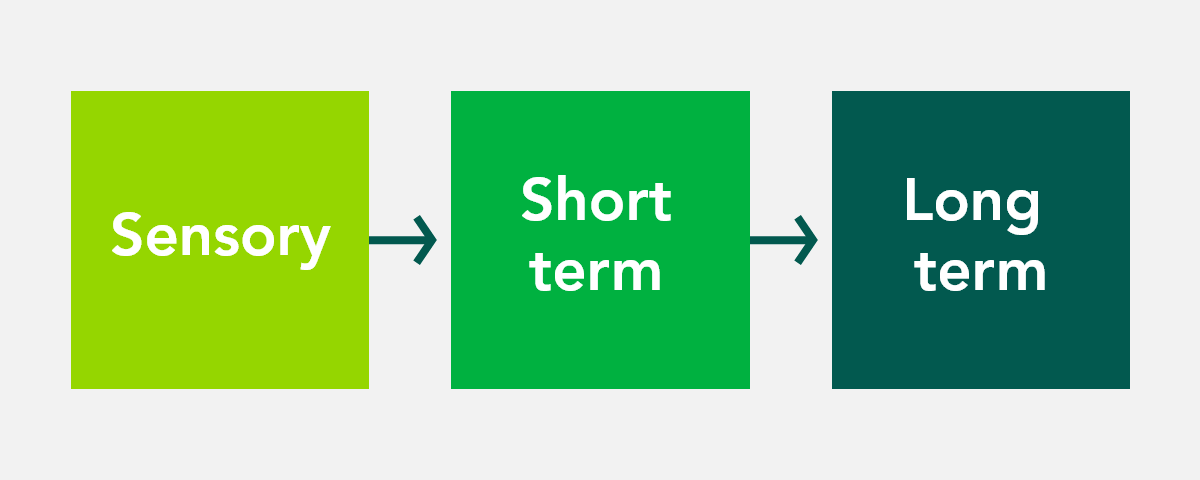
Cognitivism explores the stages of memory – sensory, short-term and long-term – to understand the mental processes influencing behaviour.
The goal is to facilitate the transition of information from short-term to long-term memory.
In alignment with Ebbinghaus’ famous forgetting curve, we also advocate a sustained campaign-based approach to learning over cramming. Spacing out and repeating lessons is an effective strategy for enhancing long-term memory retention. In practical terms, let’s take a look at how cognitivism is applied:
Example: Empowering employees to act against financial exploitation
A nonprofit seeks to empower employees to identify and address potential financial exploitation of older adults. These employees often believe they lack the authority to act, especially if they’re not certain an account holder (the customer) is being exploited.
The Solution: a game anchored in real-world scenarios
At the start of the game, learners select an account holder to protect, each with their own set of challenges, based on real-world case studies.
As they advance through the game they encounter interactive elements where choices matter, influencing the financial outcome and answer knowledge-check questions to check understanding at spaced intervals.
As the learner spots and stops exploitation, they protect the account holder’s money. And if they fail to act, they’ll lose their money!
The gamified solution acts like a simulation where the learner receives feedback on their choices, including real-life testimonials from victims and behavioural modelling videos from expert employees.

The science behind the game
Acknowledging diverse learning styles, cognitivism encourages you to integrate various presentation methods and mediums. Onscreen text, games, animation with voiceover, and interactive video cater to different preferences. Real-world scenarios connect the material to learners’ lives and simulations challenge learners to apply their critical thinking skills. As a result, this encourages active processing.
To reinforce information and aid memory retention, knowledge-check questions prompt learners to retrieve and reinforce information, aligning with cognitivism’s focus on memory retention.
In essence, cognitivism emerges as a guiding force in elearning, prioritising meaningful engagement, critical thinking, and the effective transition of knowledge from short-term to long-term memory. Far from irrelevant, after nearly a century it stands as a cornerstone for creating impactful and enduring learning experiences.
Explore more
Want to learn more about evidence-based practices for learning design?
Discover the secrets to designing impactful and engaging elearning experiences by leveraging the science of learning, in our latest guide: Creating impactful elearning – The art and science of evidence-based elearning design. Plus, you can enjoy expert commentary from renowned thought leader Dr. Philippa Hardman!